

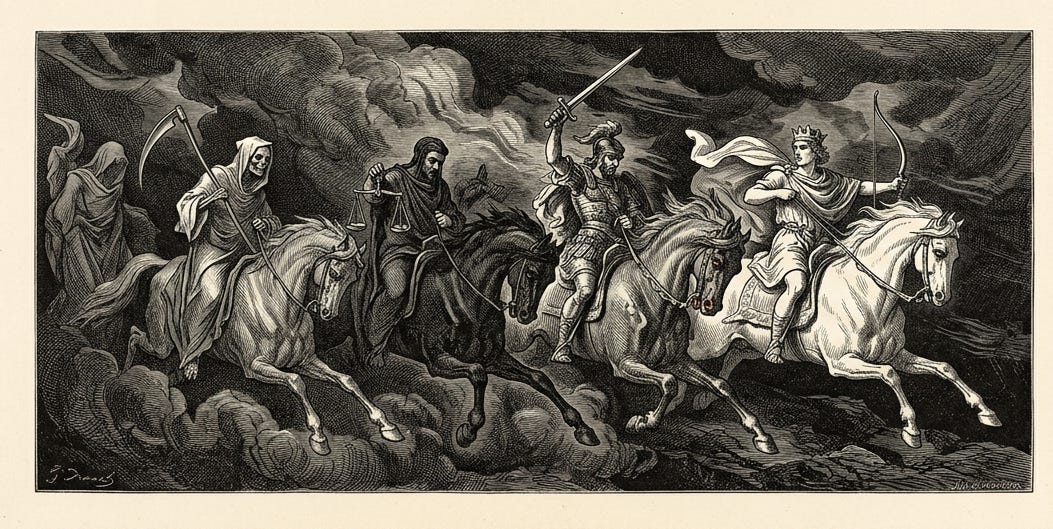
The word came not from a fringe preacher broadcasting from a strip mall church, but from a military commander addressing troops preparing to deploy. According to a complaint filed with the Military Religious Freedom Foundation (MRFF), one of more than two hundred filed in the first days of the war and reported to span more than forty units across at least thirty installations and every branch of the armed forces, the commander opened a combat readiness briefing by telling the men and women under his command not to be afraid. What was happening in Iran, he said, was all part of God’s divine plan. He cited the Book of Revelation. He named Armageddon specifically. He told them that the president of the United States had been anointed by Jesus to light the signal fire.
He had, by the complainant’s account, a big grin on his face.
In the public square, the same register has surfaced in official language. The White House press secretary, Karoline Leavitt, told reporters that the Iranian regime had been “utterly crushed,” and that Iran’s leaders were “paying for their crimes against America, and they are paying in blood.” Words like these are not only descriptions. They are permissions. They train a nation to imagine violence as cleansing and final, and they fit too naturally inside a theology that expects history to end in blood.
I am not writing this as a political critic. I am writing it as someone who takes the faith seriously enough to be alarmed, not by the mention of God in a briefing room, but by what version of God is being invoked, and to what end. The Christian tradition has seen this pattern before. It has words for this temptation: the marriage of certainty and coercion, the conversion of providence into permission, the sanctification of violence as destiny.
What follows is not an attempt to read hearts. It is an attempt to name the moral hazard of importing apocalyptic certainty into command authority. When power speaks in God’s name, the first question is never whether the speaker sounds sincere. The first question is what the speech does to conscience.
But first, we need to understand the map.
The Map
To understand why a military commander might grin at the prospect of a bloody war, you have to understand the theological system that can make that grin coherent. I want to be careful here. The complaints filed with the MRFF have been reported and summarized, and the pattern described is serious. Still, I am not in those briefing rooms. I cannot say with certainty what is in anyone’s heart. What I can say is that the theology exists, that it is held by a very large number of Americans, and that it can create a framework in which catastrophic conflict is not something to be prevented but welcomed. Whether that framework is driving policy, shaping it at the margins, or being invoked opportunistically is a question I cannot answer. The moral problem does not depend on my ability to prove it is the engine of the state. It depends on what happens when it enters the bloodstream of authority.
It is not madness. It is a map, a detailed, internally consistent account of how history ends, and the polling data alone should give any reader pause about its reach. According to Pew Research Center, one of the most methodologically rigorous survey organizations in the world, 39 percent of all American adults believe humanity is living in the end times right now. Among evangelical Protestants, that figure rises to 63 percent. LifeWay Research (a Southern Baptist organization, not a liberal institution) and Yale’s Program on Climate Change Communication have found similar numbers. Depending on how the question is asked, between 40 and 60 percent of Americans embrace key elements of the end-times framework: a sudden removal of believers, a period of tribulation, a final battle, and Christ’s return. The Left Behind novel series, essentially a fictionalization of this theology, sold more than sixty-five million copies beginning in the 1990s.
That breadth matters, but it requires a further distinction. Most people who hold an end-times hope do not hold it as a weapon. For many, the map does what anxious modern life rarely does. It offers coherence. It turns chaos into storyline, suffering into sequence, history into something legible. It promises that frightening headlines are not random and that God is not absent. The danger is not the desire for meaning. The danger is what we permit ourselves to do to our neighbors when meaning becomes certainty, and when certainty takes a seat behind a microphone in a room where no one can opt out.
The map in its modern popular form originates not in the early church, and not in the Reformation, but in the work of a nineteenth-century Anglo-Irish clergyman, John Nelson Darby. In the 1830s, Darby developed a system often called dispensationalism, the idea that God governs history through distinct eras, each ending in human failure. In Darby’s reading, the final era ends in catastrophic collapse followed by Christ’s direct intervention. Darby was not a fringe figure. He was a serious, prolific theologian who traveled widely and influenced American evangelicalism deeply. The system was codified for mass consumption in the 1909 Scofield Reference Bible, which sold millions of copies and made dispensationalism the default eschatology of American fundamentalism. Hal Lindsey’s 1970 bestseller The Late Great Planet Earth brought it to a popular secular audience. Tim LaHaye and Jerry Jenkins then embedded it in evangelical imagination at a level that no sermon ever could.
The sequence runs like this. At a moment of God’s choosing, believers are “caught up” (language drawn from 1 Thessalonians), leaving the rest of the world to endure seven years of tribulation. A final conflict culminates near Megiddo. Christ returns at the moment of maximum catastrophe. He defeats the enemy. He reigns. History, as we know it, ends.
Within this framework, specific preconditions matter. Israel must exist as a nation. It did not, for nineteen centuries, which is why 1948 carries enormous prophetic weight for dispensationalists. Jerusalem must be in Jewish hands, and 1967 confirmed that. The coalition arrayed against Israel in the final conflict is often connected to Ezekiel 38 and 39, where the prophet describes an invasion led by Gog, from the land of Magog, accompanied by nations including Persia.
Persia is Iran.
That identification has been a staple of modern prophecy teaching for decades. Mark Hitchcock, a pastor and prolific writer on biblical prophecy, has written entire books arguing that Ezekiel anticipates a future conflict with Iran as part of a coalition against Israel. John Hagee, founder of Christians United for Israel and one of the most influential evangelical voices in American political life, has built a ministry substantially around this framework. When Hagee celebrated the recent strikes as prophetically significant, aligning them with biblical feast days and End Times timelines, he was not improvising. He was reading from a map he has been teaching for decades.
The map can also explain the grin.
Revelation is not subtle in its imagery. In Revelation 14, the “winepress” of wrath yields blood in quantities that overwhelm the imagination. The text describes blood stretching for nearly two hundred miles, rising to the height of a horse’s bridle. In Revelation 19, Christ returns in conquering symbolism, his robe dipped in blood, to tread the winepress of the fury of God’s wrath. For those who read Revelation as a literal timeline, the horror is not a detail to be spiritualized. It is confirmation.
A war that is terrible enough, bloody enough, catastrophic enough, centered on Israel, involving Iran, threatening the survival of the Jewish state, begins to look, through this lens, less like a geopolitical disaster and more like the first chapters of the end. And for those who believe the end brings Christ’s return and the resurrection of the dead, the beginning of the end can start to feel like something to welcome.
That is what Mikey Weinstein of the MRFF has said he is hearing in the complaints: a posture of delight, even fixation, on how graphic the battle “must” become for prophecy to be fulfilled. Pastor and theologian Josh Olds, writing for Baptist News Global, named the central irony plainly: a faith centered on loving enemies and making peace can become, when distorted, a framework that welcomes violence and damages the witness of the church.
One nuance deserves acknowledgment. Pew’s data also shows that even among evangelicals who hold this framework, roughly seven in ten say they are uncertain whether Jesus will return in their lifetime, or believe he probably will not. Believing the map is accurate and believing you are personally positioned to trigger its fulfillment are different things. Most people who hold this theology hold it with humility about timing. The disturbing possibility raised by the MRFF complaints is not that millions of ordinary Christians want war. It is that a smaller number of people in positions of authority may be crossing a line from belief into enlistment, moving from “God will do what God will do” to “we know where we are on the timeline, and this conflict is part of it.”
To understand why that crossing matters so much, we have to go further back than Darby. We have to go back to the second century, when the church faced a similar temptation and knew what to do with it.
The ancient error
In the second century, a charismatic leader named Montanus arose in Phrygia, in what is now central Turkey, and declared that the end was not merely coming but imminent. He and his prophets, most famously Priscilla and Maximilla, claimed direct revelation from the Holy Spirit. The New Jerusalem was about to descend near a village called Pepuza. Believers were called to gather, to purify themselves, and to embrace suffering and martyrdom as spiritually meritorious. God had chosen this moment, and he had chosen them.
The movement spread. It attracted serious minds. Tertullian, one of the great early Christian intellects, eventually aligned himself with it. In an age when persecution was real, the intensity of the movement could look like courage.
But the church pushed back, and the reasons are worth recovering.
The bishops who condemned Montanism did not object to belief in the Second Coming. Every Christian believed in the Second Coming. They objected to something more specific: the claim that the timeline could be known, that special revelation entitled leaders to command the faithful toward it, and that suffering and danger were therefore not merely endured but sought. The tradition named this a distortion on multiple grounds.
First, “no one knows the day or the hour” is not a riddle to be solved by sufficiently clever interpreters. It is a boundary. Second, using spiritual authority to send people toward danger on the grounds that their suffering serves prophetic purpose is not faith. It is manipulation. Third, and most precise, the movement treated God as a mechanism to be triggered rather than a sovereign to be trusted. Human urgency was mistaken for divine instruction.
The dispensationalist map is not identical to Montanism. Yet its application can commit a similar error when it enters a chain of command. Telling soldiers that the timeline is known, that the conflict is foreordained, and that their deaths serve a prophetic purpose treats human interpretation as divine instruction. It turns providence into permission. It substitutes certainty for discernment.
When the warning went unheeded
The church has not always remembered its own answer. The most consequential instance of forgetting is also the most relevant to the phrase that shadows this essay.
In November 1095, Pope Urban II addressed a crowd at Clermont. The speech wove together grievances and fear with a promise of spiritual reward and sacred destiny. The crowd’s response became one of the most famous phrases in medieval history: Deus vult. God wills it. The First Crusade was launched.
What followed was not only war abroad. It was blood at home. Jewish communities along the Rhineland were massacred before the armies even reached the Holy Land. Constantinople was eventually sacked by crusaders who were supposedly defending it. The project culminated in failure and left behind a moral stain that still haunts Christian memory.
What matters here is the structural logic. God wills this conflict. Therefore moral constraints are loosened. Those who die serve a sacred purpose. Escalation becomes evidence of faithfulness. Exit conditions vanish, because you do not negotiate your way out of God’s plan.
Missions that are claimed to be righteous missions do not tend to observe the established rules of engagement.
That phrase, Deus vult, is now tattooed on the body of the man responsible for the United States military. Defense Secretary Pete Hegseth bears it on his skin alongside the word kafir — Arabic for “infidel.” In his 2020 book American Crusade, he praised the medieval Crusades as necessary to “push Islamism back” and described the present era as “much like the 11th century.” He has hosted monthly Christian prayer services in the Pentagon auditorium during working hours, circulated videos featuring Bible verses overlaid on footage of fighter jets and paratroopers, and at this year’s National Prayer Breakfast connected the deaths of soldiers directly to the fate of their eternal souls, saying that the warrior who lays down his life for his creator finds eternal life.
Symbols do not prove motives. They reveal what stories we find worth inhabiting, what versions of history we wish to embody, and what forms of holy violence we are tempted to romanticize. The danger is not that history repeats itself with identical costumes. The danger is that the moral logic returns: certainty, sanctification, and the quiet suspension of restraint.
Three theological distortions
It is worth being precise about what is wrong here, because imprecision gives this framework room to hide. Three distortions do most of the work.
The first is the attempt to engineer the end times. A detailed prophetic map can become a practical script. If history must end this way, then actions that “move the pieces” can start to feel not merely permissible but obligatory. Faith becomes strategy. But this treats God as a mechanism that human beings can set in motion rather than a sovereign who acts in his own time. The prophets who actually received revelation about history’s end were not issued a geopolitical to-do list. Daniel received visions he struggled to understand. John saw things for which he had no adequate vocabulary. Neither presented policy as prophecy. They presented judgment as warning.
The second distortion is the weaponization of spiritual authority. When a commanding officer frames a war as divinely mandated in a setting where subordinates cannot simply decline to listen, faith becomes coercive. It is not an argument offered to conscience. It is an atmosphere imposed upon it. If a briefing tells service members not only that God governs history, but that this particular war is the fulfillment of Revelation, and that leadership has been “anointed,” then religious language is no longer pastoral. It becomes a tool of psychological pressure. The tradition has a word for using spiritual claims to override the conscience of those with no recourse: coercion. That is not evangelism. It is the mirror image of what the early church experienced from its persecutors, and vowed never to imitate.
The third distortion is the evacuation of just war reasoning. Augustine and Aquinas insisted that the use of force must be morally constrained: undertaken for a just cause by legitimate authority, pursued with right intention, and bounded by proportionality and a reasonable prospect of success. Those constraints are not decorative. They are meant to keep violence from becoming sacrament. But they cannot survive if “success” is defined as escalation toward apocalypse. Armageddon, by definition, cannot be achieved by good strategy. It requires divine intervention. When war is framed as a sacred step toward the end of history, the moral architecture built to restrain war collapses. What remains is zeal.
The most corrosive part is not the presence of God-talk. It is the way certainty makes restraint feel like disobedience.
What the prophets actually did
There is another tradition available — older than dispensationalism, older than the Crusades, older than empire’s temptation to baptize itself. It looks almost nothing like triumphalist prophecy.
The Hebrew prophets did not celebrate the armies that marched. They wept. Isaiah, who saw visions of history’s end, also spoke of the servant who would not break a bruised reed. Jeremiah dictated warnings from confinement. Ezekiel performed grief with his own body. Amos confronted comfortable religion and warned those who longed for the Day of the Lord that they had misunderstood what they were longing for. The Day of the Lord, he said, would be darkness and not light.
The vision of swords beaten into plowshares appears more than once, as if the tradition feared we would miss it. The eschatological hope is not righteous people finally getting to spill the blood of their enemies. It is the end of the need for battle at all.
Jesus’ own posture sharpens the point. When disciples wanted fire from heaven against a village that refused them, he rebuked them. When Peter drew a sword in the garden, Jesus told him to put it away. Those who live by the sword, he said, will die by the sword. The earliest Christians, for centuries, refused to treat imperial violence as their instrument — not because they were indifferent to evil, but because they believed another Kingdom was coming and could not be built by coercion.
None of this settles every question about statecraft or defense. The just war tradition exists precisely because the tradition has always known these questions are real, and that easy slogans are not the same as moral seriousness. Christians can serve with integrity. A nation can defend itself. There are tragedies in history where force may be the least-wrong option.
But there is a vast distance between sober moral reasoning about the use of force and euphoric certainty that welcomes bloodshed because it confirms a timeline. That distance is the distance between faith and its distortion.
The question worth sitting with
The early church understood that the most dangerous distortions are rarely outright denials of the faith. They are more often real threads of the faith amplified until they drown out the rest: hope without humility, providence without restraint, courage without love.
The Montanists were not inventing a new religion. They were claiming the authority to command others toward danger because they believed they knew the schedule of God. The crusaders were not disbelieving in God. They were so certain of his will that they stopped listening for it. The commanders in those briefing rooms, if the complaints are accurate, are not merely speaking about God. They are using God to thicken the air around violence until it feels inevitable, even holy.
They are grinning.
Augustine warned that power’s great temptation is to confuse the City of God and the city of man, to mistake contingent human politics for the unfolding of divine will. The cost is measured first in the lives of those who could not refuse, and later in the credibility of the church that gave sacred cover to what should have remained morally agonizing.
The faith has an answer to this. It found that answer in the second century, when a movement insisted it knew the timetable and demanded obedience to it. The answer still stands. The timing belongs to God alone. The boundary is real. Those who claim the authority to engineer what God has reserved for himself are not hastening the Kingdom.
They are mistaking themselves for it.
The faith has an answer to this. It found that answer in the second century, when a movement insisted it knew the timetable and demanded obedience to it. The answer still stands: The timing belongs to God alone. The boundary is real. Those who claim the authority to engineer what God has reserved for himself are not hastening the Kingdom.
And God does not need a signal fire.
Sources and further reading
Primary reporting on the MRFF complaints: Jonathan Larsen, independent journalist, Substack (jonathanlarsen.substack.com): original reporting on complaints from service members across more than forty units in at least thirty military installations, published March 2, 2026.
Military Religious Freedom Foundation (MRFF), Mikey Weinstein, founder and president: public communications describing more than two hundred complaints received and summarizing reported briefing-room rhetoric.
HuffPost / Yahoo News: reporting on MRFF complaint details, including specific language used by commanders in briefings, published March 3, 2026.
Theological analysis from within the Christian tradition: Josh Olds, pastor and theologian, Baptist News Global: “The end-times theology driving US intervention in Iran,” March 2, 2026.
Baptist News Global: “US military personnel object to Armageddon talk,” March 3, 2026.
Baptist News Global: “Dispensationalism is going to get us all killed,” March 4, 2026.
Good Faith Media: “Franklin Graham’s Crusade: Extremist Theology Behind Strikes on Iran,” March 1, 2026.
On Hegseth, the Pentagon, and Christian nationalism: Interfaith Alliance: “Pete Hegseth’s Christian Nationalist Crusade Is a Threat to Religious Freedom,” documenting American Crusade, Hegseth’s public praise of the historical Crusades, and the Deus Vult tattoo.
PBS NewsHour, interview with scholar Brad Onishi, December 2024: context on Crusader tattoos and Christian nationalist symbolism.
Religion News Service: “Defense Secretary Hegseth tests Constitution in Pentagon worship services,” September 2025.
CNN Politics: “Hegseth invited pastor who calls for Christian theocracy to lead Pentagon prayer service,” February 2026.
Freedom From Religion Foundation (FFRF): press release documenting Huckabee’s appeal to Trump to “hear from heaven,” Hagee and Wallnau’s prophetic celebration of the strikes, and Hegseth’s National Prayer Breakfast remarks, March 3, 2026.
MS Now Opinion / Sarah Posner: “Christian nationalism is surfacing in the war on Iran in a shocking way,” March 4, 2026.
Military.com: “Commanders Accused of Framing Iran War as Biblical Mandate,” March 3, 2026.
Middle East Eye: “US troops told Iran war ‘anointed by Jesus’ to bring on Armageddon, watchdog says,” March 4, 2026.
On the dispensationalist theological tradition: John Nelson Darby, The Collected Writings of J.N. Darby. C.I. Scofield, The Scofield Reference Bible (Oxford University Press, 1909). Timothy Weber, On the Road to Armageddon: How Evangelicals Became Israel’s Best Friend (Baker Academic, 2004). Mark Hitchcock, Iran and Israel: Wars and Rumors of Wars (Harvest House, 2013). Pew Research Center: “About Four in Ten U.S. Adults Believe Humanity Is Living in the End Times,” December 2022. LifeWay Research: pastoral surveys on end-times theology and the Second Coming, 2016 and 2019.
On the Montanists: Christine Trevett, Montanism: Gender, Authority and the New Prophecy (Cambridge University Press, 1996). William Tabbernee, Fake Prophecy and Polluted Sacraments (Brill, 2007). Eusebius, Ecclesiastical History, Book V.
On the just war tradition: Augustine, The City of God, Books XIX and XXII. Thomas Aquinas, Summa Theologiae, II–II, Q. 40.
This one is longer and a bit outside the moral reflections I’ve been writing this year. The moment felt important enough that I needed to put something down in one place. If you read it, I’d welcome your thoughts, especially where you think I’m missing something or reading this wrong.