

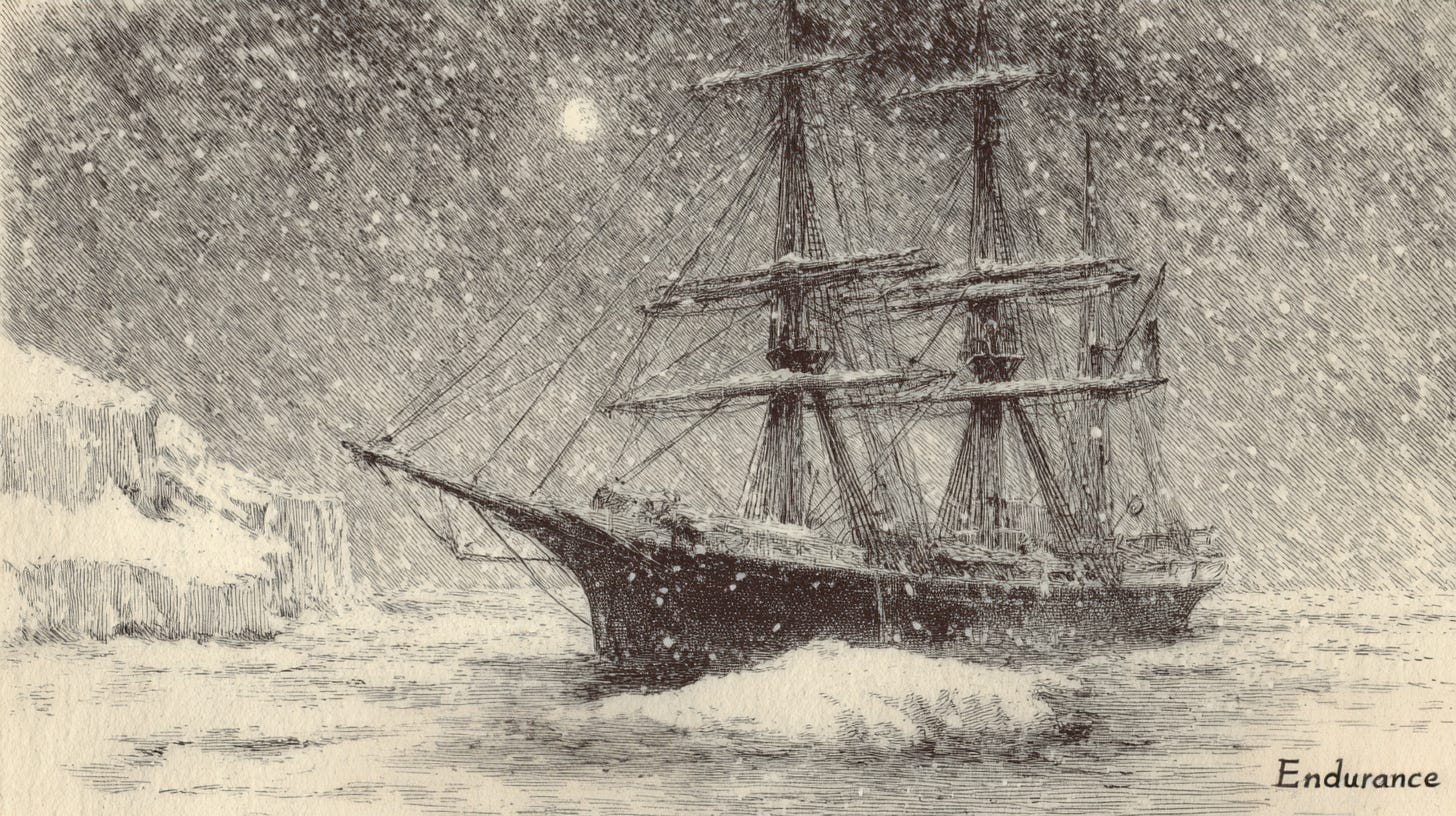
Pages from the journal of an able seaman from Leith, later set to carpenter’s work. Recovered after the expedition.
December 6, 1914, Grytviken, South Georgia
Left the whaling station this morning. Men on the quay waved as if we were away to be ghosts. The Boss went straight to the charts.
Wrote Mary a note. Tore it up. Brave words feel like lying.
December 24, 1914
Christmas Eve. The galley did its best. Pudding tasted like rope. We ate it anyway. A few songs. Too loud, too cheerful, like whistling past a graveyard.
January 10, 1915, Weddell Sea
Ice now. Broken plates. Slush that steals your boots. White that is not pure, only endless.
We moved when we could. When we could not, we waited.
January 18, 1915
Beset. That’s what the officers called it. “Held fast.” Sounds tidy on paper.
The pack closed round the hull and that was that. Engines ran hot for nothing. Sails might as well be bedsheets. The ship shuddered once, like she tried to argue, then settled into the ice.
The Boss said we would drift till the ice opened. The men nodded. Nobody said what we were thinking.
February 3, 1915
The ice made sounds at night. Pressure beneath us, like a hand on a lid. There was nothing to be done about ice but listen to it.
Daylight was worse. Same white plain in every direction. Same pale sun dragging itself along. A stillness so complete your head started making up movement. You could walk a mile out, turn, and the ship was exactly as she had been. Going nowhere.
February 20, 1915
She was called Polaris once. One of the old hands told me that like it was a joke. The Boss renamed her Endurance for a virtue he thought we’d need.
Names didn’t matter, Harris said. He said plenty those days.
March 6, 1915
They put me to carpenter’s work more often. Patching, bracing, keeping small things from becoming big things. It suited me. A man likes to be useful.
My mittens were wearing thin. I’d stitched them twice already. I would stitch them again.
March 15, 1915
Routine is a fence. You don’t notice it till somebody steps through.
Harris stopped shaving. Said there was no point. I didn’t shave either. Felt myself slipping and didn’t like it.
April 7, 1915
Football on the ice. For half an hour we were boys again. Then the ball rolled against the hull and stopped. It was ridiculous and it made me angry.
Later I wrote Mary’s name in frost on the rail and watched it fade before I finished.
June 22, 1915, Midwinter Day
Midwinter. They dressed it up like a holiday because otherwise there’d be nothing to mark. A candle. Extra biscuit. A dram for some. We laughed too loud.
For an hour the dark felt lighter. It wasn’t the dark.
July 19, 1915
Pressure in the night. Not a single groan, but a hundred small complaints. You lay there listening to timber talk to ice.
Harris asked me, quiet-like, if I thought we’d get home. I told him aye. I didn’t know why I said it.
September 22, 1915
The ship complained more now. Beams, bulkheads, a sound like teeth grinding. We went down with lanterns and looked at her insides as if looking would keep her whole.
I started checking lashings that didn’t need checking. It gave my hands something to do when my head had nowhere to go.
October 24, 1915
The pack had teeth that day. Ridges pressed up beside us like a slow animal.
Harris said, “She’s done.” Like a man naming the weather.
October 27, 1915
Abandon ship.
The words hung there. Men stood like they were waiting for the Boss to take them back. Then we got on with it, because work is what you do when you’ve nowhere to put your fear.
We hauled out stores, then tools. My kit first. Planes, chisels, nails. Things that make you useful.
Harris tried to drag a chair out. Somebody laughed. He left it and didn’t laugh with them.
November 2, 1915, Ocean Camp
We camped on the ice then. Tents low. Wind sharp. The world smaller and more honest. You were either warm or you weren’t. Either useful or you weren’t.
I fixed a latch on a provision box. It would break again. I fixed it anyway. Leaving it broken felt like agreeing with the ice.
November 21, 1915
She went down that day.
Not in a grand way. Slow. Stubborn. Like an animal refusing to perform. When the mast finally disappeared, Harris took off his cap. No one spoke.
I didn’t know what else to do, so I checked a lashing that didn’t need checking.
It’s a strange thing, watching the place you slept turn to water.
December 14, 1915, Patience Camp
We drifted. We waited. The Boss kept the men busy. He knew what idleness does.
Harris said we’d be paid in stories. I told him stories don’t buy coal in Leith. He smiled, just a flicker, then went quiet.
February 12, 1916
Frost took the tip of my finger that day.
Harris told me to keep my mittens on when I was working. I nodded. I didn’t tell him my mittens were mostly holes and I’d been pretending they were fine.
I wrapped it up and went back at the lashings. One less finger. Same watch. Same jobs.
March 30, 1916
Talk of launching the boats. The officers spoke quietly. The men listened loudly.
There was relief in the idea of movement, even toward danger. Waiting makes a man strange.
Harris said he’d rather drown than sit another month on ice. Then he mended a boot sole like he planned to live forever.
April 9, 1916
We launched that day.
The boats looked too small. We dragged them like coffins and climbed in like it was a prayer. Sea water hit my face and I was grateful for pain that moved.
April 15, 1916, Elephant Island
Land. Not the land we wanted. Rock all the same.
I kissed it without thinking. Felt daft after. Harris didn’t laugh. He sat and stared at the sea as if it had offended him personally.
April 24, 1916
They pushed off in the wee boat and the sea took them like it was nothing.
The Boss stood in the stern a moment, looking back at us. Then the James Caird dipped behind a wave and was gone. I watched until my eyes hurt and my throat did that tight thing.
After, the camp sounded different. Smaller.
May 18, 1916
Harris almost stopped talking. When he did, it was sharp, like a knife that hadn’t been used in a while.
He missed breakfast. No reason. No one pressed him.
A man can give up without declaring it. He can just stop keeping the small fences.
June 7, 1916
Someone slept through his watch. No punishment. The watch was covered anyway. Still, something felt thinner after. Like rope wearing through.
I thought about skipping mine that night. Nobody would notice. Then I pictured the beach empty in the dark and felt ashamed. I went.
July 3, 1916
We ran out of tobacco. I thought men would become wolves. Instead we became accountants. Counting crumbs. Counting minutes. Counting each other’s tempers.
Harris gave me the last of his tea without making a show of it. I pretended not to notice.
August 29, 1916
Clear sky for a moment. Stars. Cold and exact. I caught myself looking for Polaris out of habit, then remembered the ship and felt something tighten in my chest.
I tried to pray. Couldn’t find the words. I knelt anyway.
August 30, 1916
A ship.
I stared so long my eyes watered. I didn’t trust it. Thought it might be a trick of light. Then it came closer and we heard voices and men started moving like they remembered they had legs.
Harris stood up slow, like he was afraid he’d break if he moved too quick. He looked older than he should. So did I.
They called names and counted heads.
We were aboard.
I shaved.
Have you ever lived through a season when forward motion stopped, but life still had to be lived?
In 1915, Shackleton’s Endurance expedition came to a grinding halt. Imagined through the eyes of an able seaman, these journal pages trace an ordinary man holding on when the mission has failed, and the only task left is to remain who he is.