

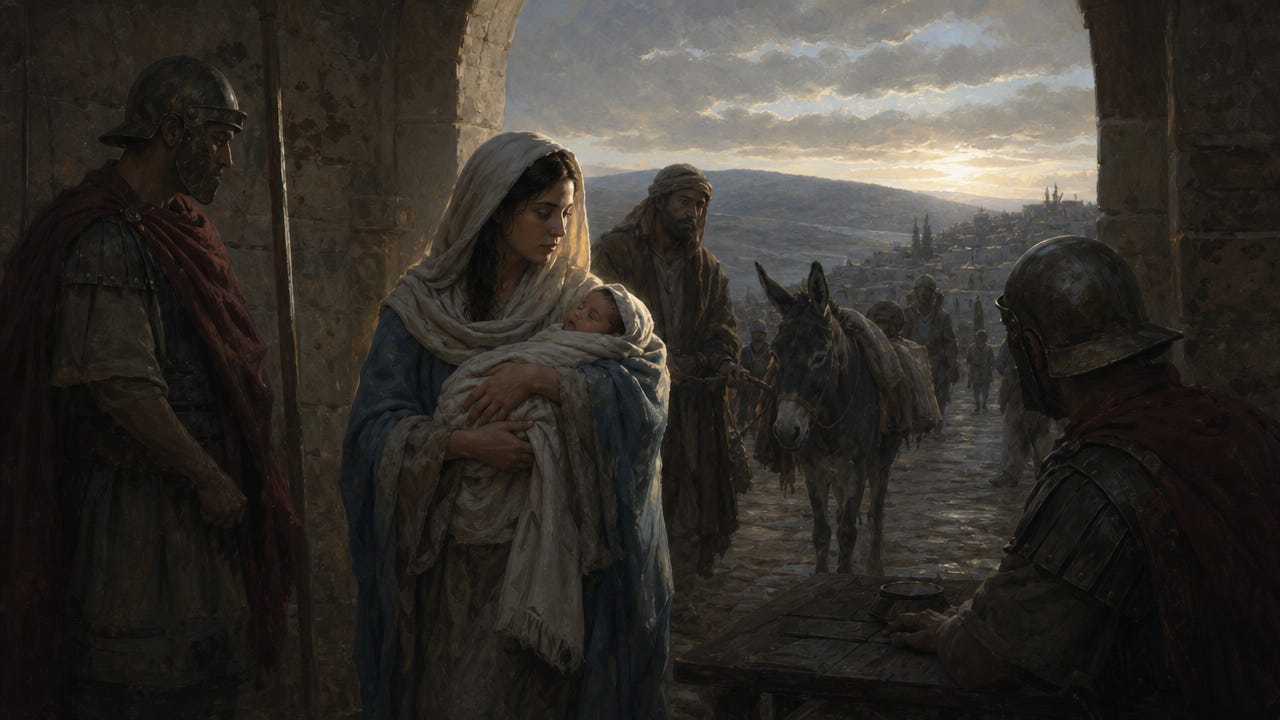
We sing about Mary as if her story were peaceful. Silent night. Holy night. All is calm. But calm is not the word that fits her life. A teenage girl in a world built to break people like her. A mother carrying a child others might want dead. Mary’s story is not gentle. It is relentless.
It begins with a yes given before she could see what it would cost.
The Weight of Water
Mary grew up in Galilee under Roman occupation, in a landscape where power was visible and often brutal. Soldiers passed through without asking permission. Taxes were collected with force. Along major roads, crucifixions marked the consequences of resistance, bodies left long enough that no one could mistake the warning.
For most families, life narrowed to survival. Rome demanded its share. The Temple required its own. Collectors took what they could. A single failed harvest could undo everything.
Nazareth itself was small, perhaps a few hundred people. Houses were cramped, often a single room with a packed earth floor, sometimes shared with animals. Privacy was not expected. Comfort was rare enough to be noticeable.
Daily life required endurance. Grain had to be ground by hand, hour after hour, the motion wearing down joints over time. Water came from a shared well, carried back in heavy jars, again and again, until the work was done. Meals were simple and repetitive. Illness moved easily through close quarters. Many children did not live long enough to grow old.
Mary knew all of this not as background but as texture, the weight of water against her hip, the ache in her arms, the quiet recalibration that follows loss when life does not pause to accommodate grief.
In such a world, safety often depended on not being seen too clearly. Remaining small could mean remaining alive. But the life she would carry would not allow for that kind of invisibility.
And above it all was Herod.
He ruled through suspicion sharpened into violence. When he heard of a child spoken of as king, he did not wait to understand. He moved to eliminate the possibility. Boys in and around Bethlehem, two years old and younger, were killed in an attempt to secure power against a threat that could not yet even speak.
For Mary, this was not distant news. It was the kind of knowledge that settles into the body, shaping how you hold your child, how you listen at night, how you measure risk without words.
Consent Without Guarantees
Into that world, the announcement came.
We often imagine the moment as quiet, almost gentle. But nothing about it would have felt safe. Mary was young, likely still in early adolescence, and not yet fully married. A pregnancy under those conditions carried consequences that were social, legal, and potentially lethal.
The law allowed for severe punishment. Even where mercy intervened, there would be loss: of reputation, of stability, of the future she had been moving toward. Joseph’s response was unknown. Her place in the community could dissolve quickly.
What she is offered is not protection, but significance. A role in something larger than herself, without any accompanying assurance that it will end well for her.
A child associated with kingship would draw attention, and attention, in that setting, was rarely neutral. It exposed, it marked, it placed a person within reach of forces they could not control.
Mary’s response is often described as submission, but that flattens it. It is closer to consent given in full awareness of risk. She agrees without clarity, without leverage, without a timeline for resolution. Nothing in the moment guarantees that her life will become easier, only that it will become different.
Faith, here, does not look like confidence. It looks like stepping forward without a map and remaining there.
Three Hundred Miles
The warning comes at night. Urgent, unnegotiable. They leave quickly, carrying what they can, before the decision has time to settle into fear.
A young couple, a child, and the knowledge that staying is no longer an option.
The road to Egypt stretches for hundreds of miles, long enough that distance itself becomes a condition of life. They move through unfamiliar terrain, rationing food and water, measuring each day by what remains. Money thins out. The child cries. Sleep is uneven and often exposed.
They depend on strangers in ways that require both trust and caution. Questions can linger too long. Answers can cost more than silence. There is no clear destination beyond “away,” no guarantee that the next place will be safer than the last.
Egypt offers distance, not belonging. They arrive as outsiders, recognizable by speech, by habit, by the small differences that mark a person as coming from somewhere else. Work is uncertain. Shelter is temporary. Stability, when it appears, is provisional.
They wait there for years.
Mary raises her child in a place that does not quite hold her. She learns how quickly circumstances can shift, how survival can depend on the mercy of people who have no reason to extend it, how a life can be carried across distances without ever fully settling.
It is not an unusual story, then or now. It repeats in different languages, under different names, whenever leaving becomes the only way to remain alive.
Thirty Years of Silence
Eventually, they return, though not to safety in any complete sense. They choose Nazareth again, a place small enough to disappear into, where labor fills the days and obscurity offers a kind of cover.
What follows is mostly unrecorded. Not because nothing happened, but because what happened was ordinary.
Mary resumes the work that sustains a household. Grinding grain. Carrying water. Repairing what wears out. Teaching her child how to pray, how to listen, how to inhabit the stories that shaped her own life. She watches him grow into the promise she was given without ever being told when, or how, that promise will take form.
Waiting stretches, not dramatically, but steadily. It asks for repetition. It asks for trust without visible progress. It asks a person to continue investing in something that has not yet revealed its shape.
Most lives unfold here, in this long middle. Not in moments of clarity, but in the accumulation of small, necessary acts that do not announce their significance.
When Jesus begins to teach, things change. His words draw attention, and attention gathers risk. He speaks in ways that challenge existing structures, and those structures respond. Crowds form. So does suspicion.
The tension Mary has lived with for decades sharpens into something immediate. The danger she once fled is no longer distant or avoidable. It is tied to her son’s choices, his voice, his visibility.
The Gospels suggest concern from his family, even attempts to intervene. That detail matters. It suggests that faith does not erase fear, and that love does not always align easily with what is unfolding.
She had once carried him out of danger. Now she cannot move him away from it.
At the cross, everything converges. The risks that began as possibility become fact. She stands there with the full knowledge that her presence will not change the outcome.
Faith does not prevent this moment. It sustains her within it.
What Fidelity Costs
Mary’s life resists being softened.
She is not protected from violence or insulated from grief. She does not receive a version of the story where obedience guarantees ease. Instead, her life moves through displacement, uncertainty, long stretches of obscurity, and a loss she cannot prevent.
What remains consistent is not the outcome but her presence within it.
She continues. Not because the path becomes clearer, but because the commitment does not dissolve when clarity does. The yes she gave does not expire when it becomes difficult to recognize.
We often imagine that faithfulness will simplify things, that it will confirm itself through results we can measure. Mary’s life suggests something quieter and more demanding. That faithfulness is what persists when those confirmations do not arrive.
It is less about understanding than about remaining.
Faith is not certainty. It is fidelity.
Not clarity, but a willingness to stay. Not protection from what unfolds, but presence within it.
We honor her more truthfully when we allow the story to keep its weight, when we resist turning it into something easier to carry.
Because what sustains a life is often carried without recognition: in bodies that keep moving, in choices made without guarantees, in the long work of continuing when stopping would make more sense.
And what is faithful is unseen.