

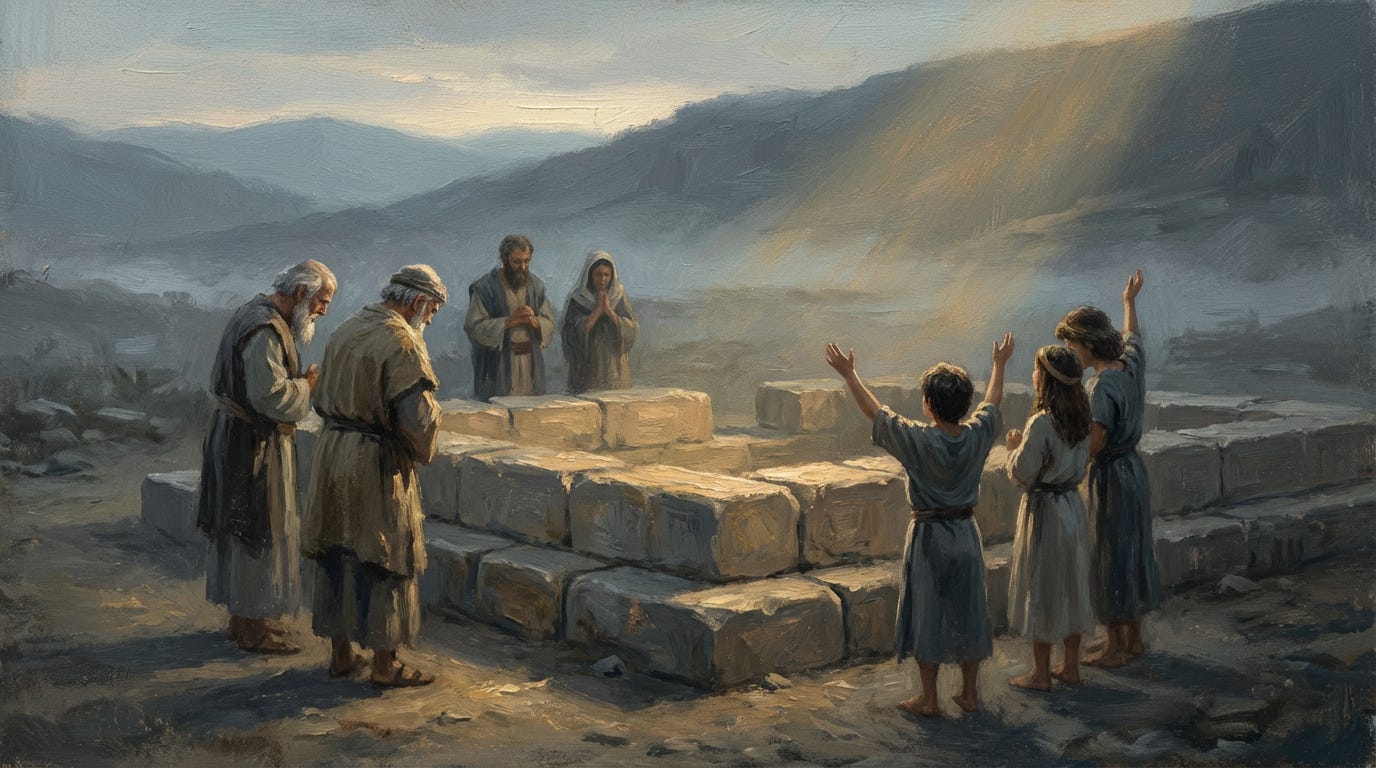
The Sound at the Foundation
In 539 BC, Cyrus the Great issued a decree that changed the ancient world. The Persian emperor, having conquered Babylon, permitted the Jewish exiles to return to Jerusalem and rebuild their temple. For the displaced Jews who had spent nearly seventy years in a foreign land, the decree must have felt like the world turning right side up again.
The return was not triumphal. The people who walked back to Judah found a city in ruins: broken walls, a temple site reduced to rubble and overgrowth, a landscape that matched the desolation they had carried in their hearts. Many of the returnees had never seen Jerusalem at all; they had been born in Babylon, raised on stories of a city they carried in memory but had never touched.
When the foundation of the new temple was finally laid, something strange happened. The younger generation, seeing the fresh stones, shouted with joy. But the old men, who remembered Solomon’s temple in its scale and splendor, wept aloud. The sound carried far, and according to Ezra, no one could distinguish the shouts of joy from the weeping; it was all one noise, rising together.
That image has stayed with me. Not because the elders were wrong to grieve. They had carried a memory across decades and distance, and what they were looking at now was modest by comparison. Their grief was holy.
But grief has a second life. Left alone, it becomes longing; left longer, it becomes a blueprint. The ache for what was lost becomes a plan to rebuild it, stone by stone, exactly as it was. That is the moment when something sacred hardens into something dangerous, not because the past wasn’t good, but because the past isn’t a place you can return to. It is a place you carry.
We are living in an age of attempted restoration. Across the political spectrum, the dominant instinct is not to build something new but to recover something lost. The language varies. The blueprints point to different decades. But the conviction is the same: the good world is behind us, and the task is to go back.
It never works. Not because the longing is foolish, but because time is not that kind of road.
⸻
The Vocabulary of Return
Consider Britain. The campaign to leave the European Union ran on a promise that was, at its core, restorative. “Take back control” carried an image of a self-governing Britain that had existed before Brussels, before open borders, before the world became so entangled that even fishing required multinational negotiation. The emotional engine was not hatred or ignorance. It was homesickness, a longing for a country that felt recognizable.
The frustration was legitimate. The dislocation was real. But the destination was not. The world Britain had once governed had already changed shape. Supply chains, labor markets, and finance had reorganized beyond any clean return. Sovereignty could be reclaimed in law; the world it was meant to govern had moved on.
What emerged was not the Britain that was promised, not simply because the promise was flawed, but because restoration never delivers what it advertises. The blueprints were drawn from a building that no longer exists on a street that has been rezoned.
⸻
The Mirror on This Side of the Atlantic
We are not observers of this pattern. We are living inside it.
“Make America Great Again” is, grammatically and spiritually, a restoration project. It points backward to an earlier version of the country, though the specific decade varies. Its progressive counterpart is less explicit but structurally similar: a longing for a recent past when institutions felt stable and the trajectory seemed predictable. Different decades, same instinct.
Both sides are grieving something real. The loss of industrial stability, of cultural coherence, of institutional trust. These losses are not imaginary. They deserve to be mourned.
But mourning is not a policy platform. And grief, however holy, makes a poor architect.
Technology has reorganized labor. Demographics have shifted. Artificial intelligence is rewriting the economy while we argue about which version of the past to restore. The America of 1955 and the America of 2014 are both gone, not because someone broke them, but because time does what time does: it moves.
We want to go home. All of us. That is the most human thing in the world. But home, as we remember it, is not a place on the map anymore. It is something more like the temple in Ezra: a promise carried forward, not a structure we can reconstruct.
⸻
What Renewal Actually Looks Like
Restoration is the easier choice, not because people are foolish, but because the past provides a picture. We know what the old house looked like. Building forward means working without that certainty, and uncertainty is hard to bear.
That is why the years after the First World War produced Versailles. Exhausted and grieving, the victors reached for familiar patterns: punish the aggressor, restore balance, return Europe to something like the old order.
Within twenty years, the house was burning again.
After the Second World War, something different happened. Scarred by that failure, the architects of the postwar order refused the old blueprints. The Marshall Plan invested in former enemies rather than punishing them. The European Coal and Steel Community bound together the very industries that had fueled war. West Germany was not restored to what it had been; it was invited into something that had never existed before.
It was not a return. It was a decision to build forward, and it produced the longest sustained peace in European history.
This is what renewal looks like when it is chosen honestly. It does not deny the past. But it refuses to let old blueprints dictate new construction. Jean Monnet captured the shift: “We are not forming coalitions of states, we are uniting people.”
Václav Havel described the posture this requires: hope is not the conviction that things will turn out well, but the certainty that something makes sense regardless of how it turns out.
Christian hope names that same posture in different language. The resurrection of Jesus is not a restoration of the world as it was; it is the beginning of a world made new, continuous with the old yet transformed beyond it. To belong to that story is to trust that building forward in love is never wasted, even when we cannot see the outcome.
Renewal, it turns out, is not a feeling. It is a practice: the daily decision to build with what we have rather than mourning what we have lost.
⸻
The Mingled Sound
I keep coming back to that scene at the temple foundation: the weeping and the shouting, so intertwined that no one could separate them. Perhaps that is what honest renewal sounds like. Not pure joy. Not pure grief. Something more tangled and human than either.
The elders were not wrong to weep; the young were not wrong to celebrate. The mistake would be to let the weeping harden into a blueprint, to insist that the new house must look like the old one.
The postwar generation understood this. They grieved what had been destroyed, and then they built something that would have been unrecognizable to the world that came before. It was smaller, less certain of itself. But it held, because it was built for the world that existed, not the one that was remembered.
Refusing the comfort of old blueprints when they no longer fit the street you live on is costly. It may also be the only way to love your actual neighbors rather than the ones you wish you still had.
What would it look like, in our politics, our churches, our own lives, to stop reaching for the old plans and build honestly with what we have? I suspect it sounds like that temple foundation: grief and hope, rising together until no one can tell them apart.