

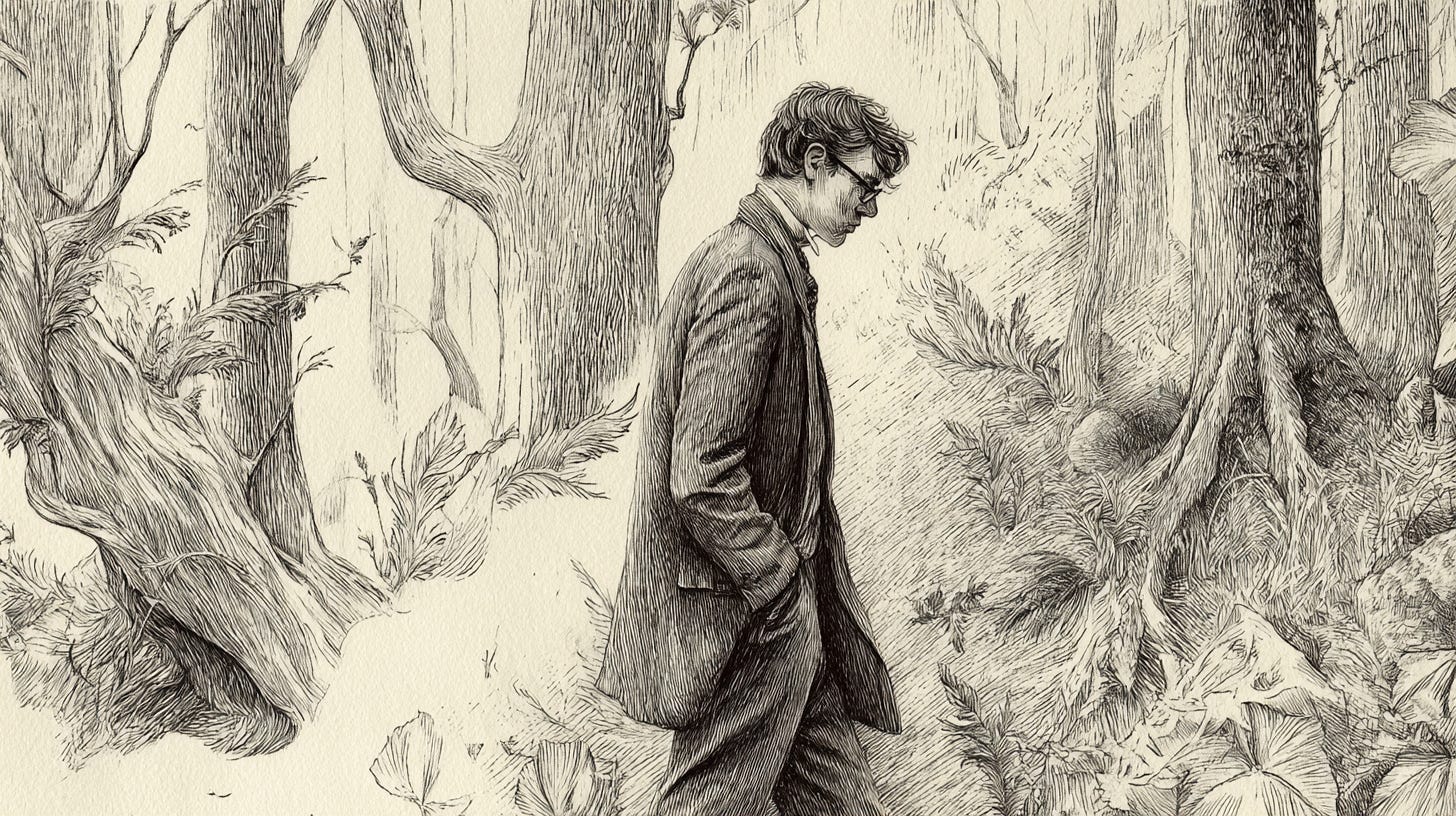
The Hand
I was walking in the woods when the thought arrived. Before I had finished thinking it, my hand was moving toward my pocket.
Not to capture anything. There was nothing remarkable to photograph. It moved because that is what hands do now when the mind stirs. Reach. Unlock. Scroll. A liturgy performed dozens of times a day without decision, without asking what it interrupts.
I stopped it that time. Stood there feeling foolish, caught in the act of fleeing something I could not name. The woods were quiet. The light was still falling.
What was I reaching away from?
Mercy
We talk about distraction as if it were purely a failure of will. The mind wanders. The discipline breaks. We reach for the phone because we are weak, because the world is engineered to steal focus.
All of that is true. But it is not the whole truth.
Distraction is often mercy. It rescues us from boredom. From loneliness. From anxiety, grief, guilt, and the weight of decisions we have not made. Sometimes it rescues us from prayer, from the silence where we might have to listen.
We do not reach for noise because we love noise. We reach because silence contains something. The phone is the exit we always carry, the door that opens onto anywhere but here.
The Thing in the Silence
My silence, when I let it arrive, sounds like this: my own breathing, louder than I expect. Wind in branches. A bird I cannot identify. My footsteps on leaves.
And underneath, fainter: a conversation I had handled badly. A decision I had been postponing. The low hum of guilt about nothing in particular and everything at once.
This is what I was reaching away from. Not the woods. The interior life the woods made audible.
Distraction is a way of managing conscience without confronting it. The mind raises a question, the thumb opens an app. The soul tries to speak, the feed drowns it out. We do not decide to avoid the interior life. We simply keep it at bay, one small interruption at a time, until avoidance becomes atmosphere.
The loss is not time, though we lose that too. The loss is depth: the ability to remain with reality long enough for conscience to form, for conviction to settle, for the world to become fully visible.
Darwin’s Worms
In 1837, a young naturalist presented a paper to the Geological Society of London on an unlikely subject: the common earthworm. His name was Charles Darwin. He would spend much of the next four decades returning to them.
The work was not glamorous. He observed how worms dragged leaves into their burrows and noticed they pulled them in by a narrow end, a detail suggesting practical intelligence in a creature with no eyes. He tested what they could sense. He measured what their castings did to the land. He watched long enough to notice changes invisible to anyone in a hurry.
His final book, published in 1881, was about worms.
What Darwin found was this: the surface of the earth is shaped, in part, by patient, invisible labor. Not dramatic forces. Not visible events. The slow work of small creatures, unnoticed, over time.
He could only see it because he stayed.
What the Worms Know
There is a moral claim hidden in Darwin’s worms, though he would not have put it that way.
The world is reshaped by the slow labor of the small. What is most consequential is often least dramatic. Reality yields itself to patient attention, and only to patient attention. The worms were always there, always working. It took a man willing to watch them for years to see what they were doing.
We have nearly lost the capacity for this kind of seeing. Not because we are less intelligent than Darwin, but because we have built an environment that makes sustained attention difficult. The feed wants the next click, the next scroll, the next small hit of novelty. It does not want us to stay with anything long enough for the slow truth to surface.
But the things that matter most, conscience, conviction, love, the gradual reshaping of a life, are not fast. They are worm-work. They happen beneath the surface, over time, and they become visible only to those who stay.
Patience of this kind is not only scientific.
The Noonday Demon
In the third and fourth centuries, thousands of men and women left the cities of the Roman Empire and walked into the Egyptian desert. They were not refugees. They were seeking something the cities could not provide: a place to face God without distraction. They built cells, lived in silence, and discovered that the mind generates its own noise.
They called the condition acedia, a restless inability to remain present. The eyes wander to the door. The thoughts drift to what is happening elsewhere. The soul becomes convinced that real life is anywhere but here. Evagrius Ponticus named it the noonday demon because it arrived when the day stretched out, when nothing was happening, when the cell became unbearable.
The symptoms sound uncomfortably modern: compulsive restlessness, inability to stay with a task, a longing for something, anything, other than what is in front of you.
They did not treat this as a minor failing. They considered it a slow evacuation of the soul. The remedy was simple and brutal: stay in your cell. The cell will teach you everything.
We carry the opposite of a cell in our pockets. The endless exit. The door that never closes. The assurance that we never have to stay with any silence long enough to hear what it contains.
Return
I went back to the woods last week. Same trail. Same light through branches.
The thought came again, not the same thought, but the same shape. A flicker of something half-formed. And the hand moved.
This time I watched it. Felt the pull, the small urgency, the voice that said capture this or check that or simply elsewhere. The hand hovered. The moment stretched.
I let it stay.
Nothing dramatic happened. No epiphany. Just the woods, growing slowly more visible. A mushroom on a fallen trunk I had not noticed. The sound of my breathing. The thought I had been half-thinking, allowed to finish itself: a small grief I had been carrying, now heavy for a moment, now allowed to be set down.
This is what attention makes possible. Not productivity. Not mindfulness. Just the slow return of the world, the self, the real, emerging like shapes from fog when you stop interrupting them.
The worms are still working. The silence still has something to say. And the hand, for now, learns to remain where it is.